Turn Snowflake metadata into cross-system context.
Snowflake holds the models, logic, and transformations your business depends on. Sweep makes that metadata part of a cross-system Agentic Layer, so teams and agents can understand how Snowflake connects to Salesforce, Data 360, and the workflows downstream.
Before you refactor, migrate, or automate, see what depends on what across the systems your business actually runs on.
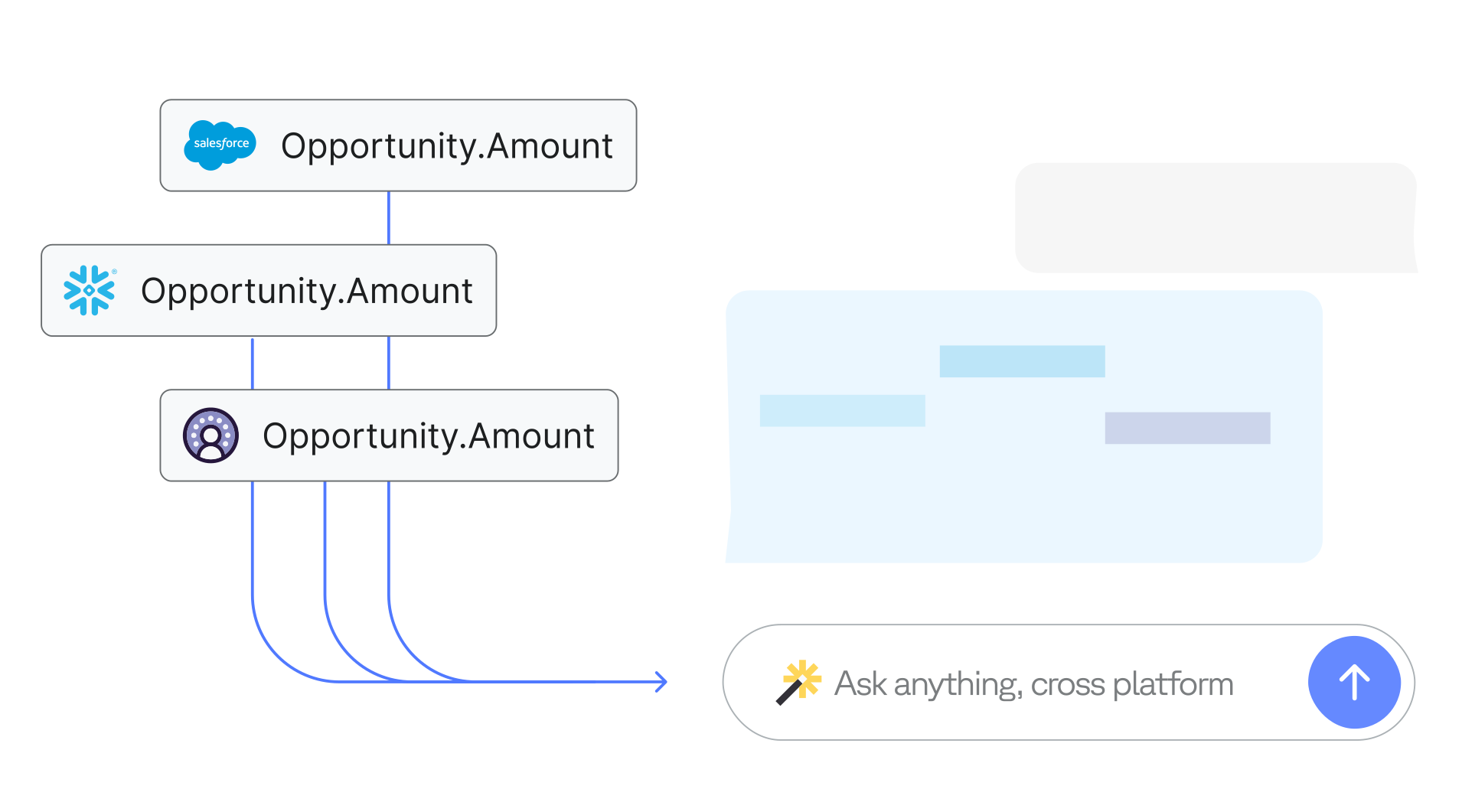
One layer. Every system. Built for complexity.
Sweep extends the same Agentic Layer your Salesforce teams already use into Snowflake, bringing the warehouse into one Unified Metadata Graph that teams and agents can reason over for logic, dependencies, and cross-system impact. The deeper and more connected the warehouse, the more context the layer holds: the same Discover → Design → Build → Monitor lifecycle, now across the warehouse.
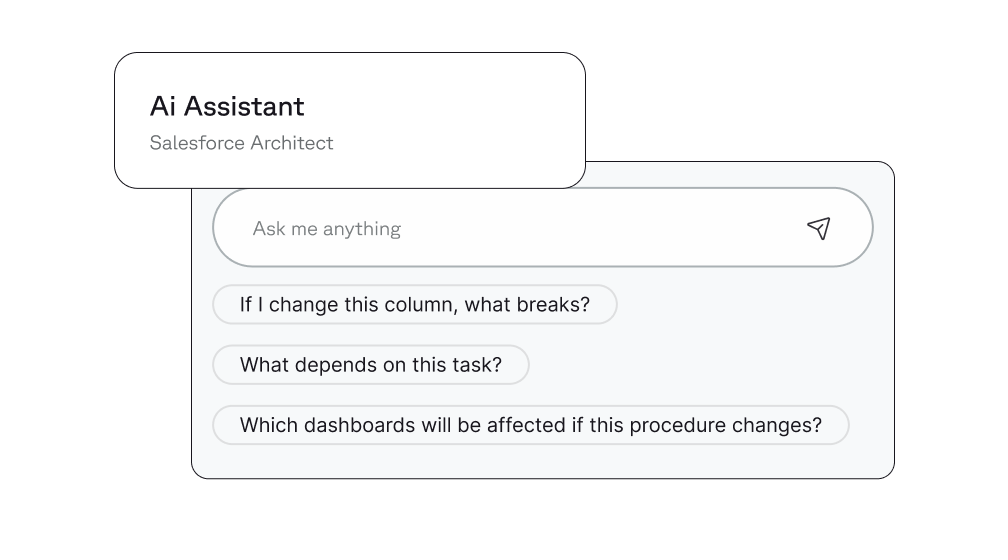
Ask across Snowflake and the systems it connects to.
sk in natural language about tables, views, stored procedures, tasks, streams, UDFs, stages, sequences, and the SQL that ties them together — plus the Salesforce and Data 360 metadata upstream and downstream. Sweep parses the SQL inside views, procedures, and tasks to map object- and column-level references, so you see what exists, how it's connected, and what may be affected before you change anything.
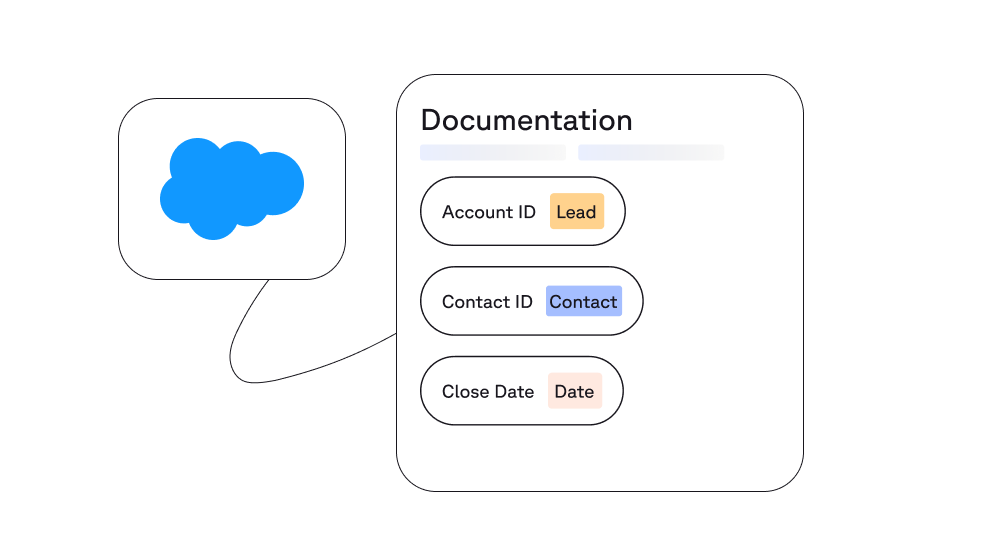
Document warehouse logic that explains itself.
Generate documentation grounded in real Snowflake metadata and SQL — purpose, ownership, execution context, and upstream/downstream relationships per object — so technical and business teams share one source of truth for how the warehouse is actually built.
See cross-platform dependencies before you deploy.
Trace how Snowflake objects relate to each other and to Salesforce and Data 360 in a shared workspace — so the warehouse team isn't the last to find out about an upstream change.
What you unlock with the Snowflake Platform
Run impact analysis before the change, not the post-mortem after.
Most Snowflake breakage is inherited. A field changes in Salesforce, and a view returns nulls, a procedure miscalculates, a metric drifts. Sweep maps those dependencies across Salesforce, Snowflake, and Data 360, so you can assess blast radius before a change lands.
Stop rediscovering your own warehouse.
As Snowflake grows, structure drifts - logic stacks, ownership blurs. Sweep keeps a continuously updated model of the warehouse, including the stored procedures, tasks, and streams schema-only tooling tends to miss, so every project starts from the current state.
Reason across all three systems - not just inside one.
Sweep's advantage is the join: a single dependency traversal from a Salesforce field, through Snowflake transformations, to a Data 360 segment or activation. That's the reason to choose Sweep over warehouse-only metadata tools.
Give agents Snowflake context they can trust.
Sweep maps your warehouse metadata and its cross-system relationships up front. So when an agent answers a question about a table, view, or procedure, it draws on the real objects and SQL references in your environment rather than guessing from training data.
Understand your warehouse. Change it safely.
The Snowflake Platform brings clarity to complex data systems by making logic, dependencies, and cross-system impact visible.